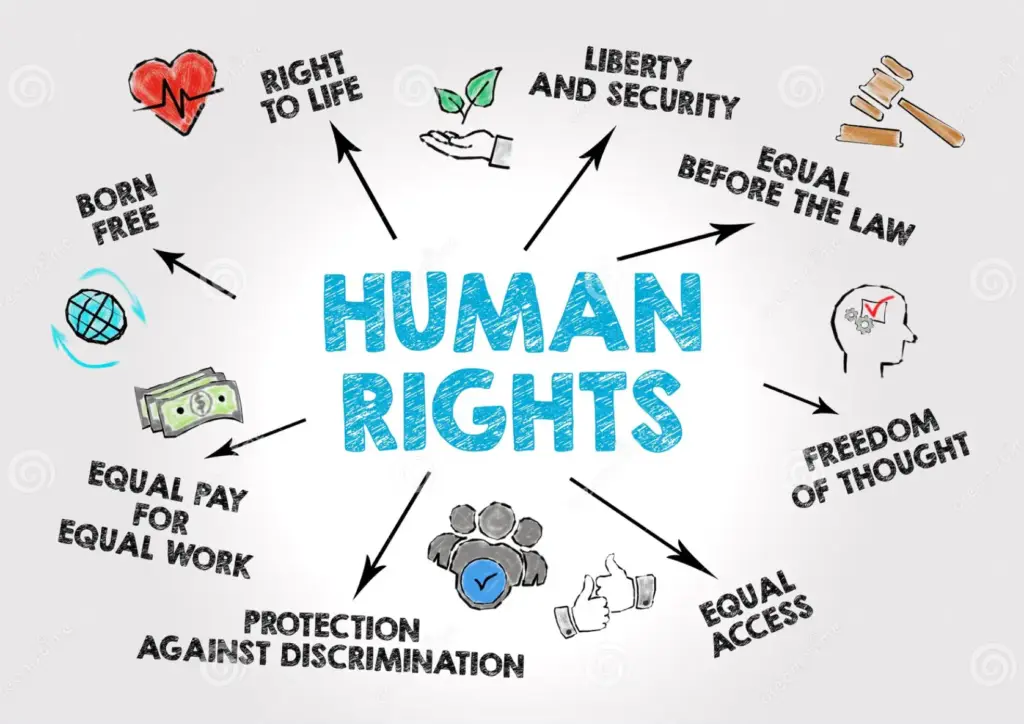
Have you ever wondered what makes Human Rights Law so special? A question that most citizens may not ponder on a daily basis. What makes Human Rights law so special is the fact that it is a piece of legislation that protects various groups against unfair treatment. Without it, society, as we know it, would return to a market that favours more dominant groups over others; and a market that typically permits practices that limit group involvement. A result that can lead to a stagnant economy and increased criminal activity.
Firstly, when one thinks of capital markets, consumerism usually is the first thing that comes to mind and the good old saying that “the customer is always right.” However, what if this is at the cost of inclusion. A concept that is important when contemplating the effect of removing legitimate opportunities from a culture and only leaving illegitimate opportunities as the only available option.
In particular, when one considers how socialization occurs, it becomes quickly apparent how the interests of majority groups can drown out the interests of minority groups; and how this may result in a violation of a person’s Human Rights.
For instance, when in unregulated markets, employers tend to look the other way when it comes to harassment and discrimination in the workplace, as well as in hiring practices.
This leads to a system of uneven power dynamics. A problem that occurs as well in regulated markets, specifically when human rights enforcement is sparse. This means that certain communities have to go without employment or have to endure unfair treatment in the employment market. A consequence that leads to high unemployment.
Now, let us explore the employment sector’s hiring model and how this is affected by Human Rights law. In the beginning of hiring processes, the employer sends out an ad specifying job requirements, which viable candidates meet; however, during the interview process, persons with a certain hairstyle or accent are given more preference than others, which results in candidates with twists or foreign accents to be screened out at a disproportionate rate.
This may not seem like a problem at first glance, but once you consider W.E.B Dubois’ “Talented Tenth” theory, one starts to realize the negative implications of reduced involvement from specific communities.
In furtherance, W.E.B Dubois’ theory of a talented tenth was the idea that a group was only as powerful as its ten percent of group membership. This meant that, if your group did not control any form of economic resources and political influence, that the group could not thrive and would fall prey to the interests of more dominant groups.
Thus, if your group is screened out of most jobs that pay over 100 thousand dollars a year, that said group would not be able to fund actions like protesting and lobbying. This is important because weak economic power means weak political power.
This is an issue in relation to the fact that it leads to one group in society having more money than they can deal with and another group not having enough resources to sustain themselves. This prevents money from spreading out and creates two types of areas: one that is underfunded and one that has inflated value.
A problem that can only be fixed by creating more shrewd business owners and skilled labourers in underfunded regions. This is why concepts in Human Rights legislation like constructive (indirect) discrimination are so important. Concepts that factor in equity numbers and mandates employers to fulfill inclusion numbers. An effect that helps bring more wealth in to a community; so, it can cycle through lower tiers, for the whole point of money is to grow an economy (society) opposed to filling a society with decadent lifestyles.
In reference to business owners, Human Rights Legislation allows business owners to place their businesses in more profitable areas. This is essential since franchises and corporations have become vital to modern economies. If a business is stuck in a low income area, it is less likely to build capital in a meaningful way. This is why Human Rights law changing zoning by laws is so essential, especially with the fact that Human Rights law prohibited lending institutions from implementing discriminatory policies that prevented persons from certain minority groups from obtaining many types of loans.
Consequently, Human Rights law protects various groups in society, but specifically protects minority groups against more dominant groups. A dialogue that sometimes gets turned black and white. In the end, Human Rights law is imperative when less fortunate groups need grow to their communities and need to find more legitimate ways to generate income to do so. Without it, minority groups would have to rely less on legitimate ways to form income and would have to find subsistence through black markets opposed to traditional ones. If you have any questions in reference to Human Rights law, feel free to make a booking with us today for free legal advice.